
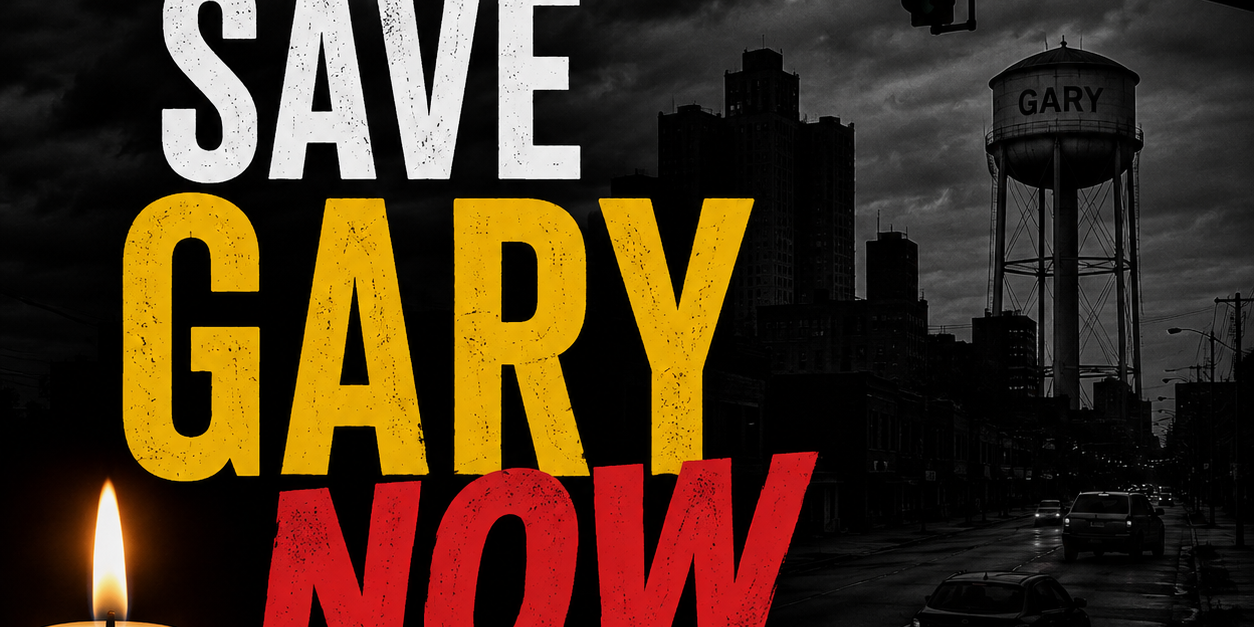
When the Lights Go Out, Leadership Must Turn On: Gary’s Power Crisis Is a Warning We Cannot Ignore
By Dr. LaDonna Raeh
At 2:32 p.m. on Wednesday, something didn’t make sense.
I had just received a phone call from Dr. Mila Marshall, who told me that Gary, Indiana, was experiencing widespread power outages following the devastating storms. As a journalist, my first instinct was to verify the information and see what had already been reported.
I searched.
Nothing.
I searched again.
Still nothing.
I couldn’t find any meaningful news coverage explaining the severity of what was happening in Gary. For a city experiencing one of the largest utility failures in its history, the silence was alarming.
So I did what journalists are supposed to do.
I started making phone calls.
One of my first calls was to Methodist Hospitals’ Northlake Campus in Gary. I identified myself as a reporter with WVON 1690 AM and asked a simple question:
“Are you without power?”
The answer stunned me.
“Yes, we are.”
That one confirmation immediately changed the direction of my reporting. If a major hospital was acknowledging it had lost power, then this story was far more significant than a routine weather update.
Dr. Marshall also connected me with Timothy Alston, an Executive Board Member of the Black Water Professionals Alliance who also works for the City of Gary, Indiana. Speaking from inside the city as crews were responding to the disaster, Alston described widespread damage caused by hurricane-force winds, fallen trees, power failures, and the tremendous strain placed on critical infrastructure. He explained how water operations had been affected, how facilities were relying on emergency systems, and how residents across Gary were still struggling without electricity.
Those conversations confirmed what I feared:
This wasn’t simply a power outage.
It was a community-wide emergency.
And yet, at that moment, very few people outside Northwest Indiana seemed to know why the lines at the gas station were wrapped around the corner in Hammon, IN, and the southern suburbs of Chicago.
I verified the pieces that needed updating before folding them in: Gary Mayor Eddie Melton declared a local disaster emergency on August 12; Gov. Mike Braun has activated the Indiana National Guard; NIPSCO now says roughly 90% of impacted customers may not be restored until Tuesday, August 18, with full restoration projected by Friday, August 21; and Methodist Hospitals confirms Northlake and Southlake have power restored while Midlake remains without power.
Tuesday’s storms ripped through Northwest Indiana, leaving downed trees, damaged homes, blocked streets and an electrical system overwhelmed by the destruction. By Thursday, much of Gary was still in darkness.
And I don’t have to imagine what that darkness looks like.
Who was there?
Very few drove through Gary Wednesday night, and it was unbelievable. Not one dark house here or a dark block there. Block after block swallowed in darkness. Some were helping people get hotel rooms because, for some residents, staying home simply wasn’t an option.
And then I spoke with a Gary resident who has lived there for approximately 50 years.
Her power was still out.
Her food was going bad.
She told me she had never experienced anything like this.
That’s when this stopped being a story about electricity.
This is about survival.
What Happens When Electricity Is Medical Care?
When most of us hear the words power outage, we immediately think about spoiled groceries, dead cell phones, and living without air conditioning. But for thousands of people, losing electricity is far more than an inconvenience. It can mean an oxygen concentrator suddenly stops working. It can affect someone who relies on a ventilator, nebulizer, or another electrically powered medical device. It can jeopardize refrigerated insulin and other life-saving medications. It can interrupt dialysis treatments or create dangerous conditions for a family with a newborn or a senior citizen sitting in a home that’s becoming hotter by the hour. It can even prevent a patient from leaving the hospital because the medical equipment they depend on at home requires electricity that simply isn’t there.
At that point, a power outage is no longer about comfort—it becomes a public health emergency.
I know this reality all too well. My father depends on oxygen, and when the power once went out at his home, I happened to be there. His oxygen equipment relied entirely on electricity, and I had to call 911. That experience forever changed the way I think about outages. So when I hear that hundreds of thousands of customers have been affected by this week’s storms, I don’t just see a number on a screen. I think about how many fathers like mine are sitting somewhere without power. I think about daughters who aren’t there when the lights suddenly go out. I think about families who can’t afford a generator, don’t have money for a hotel, or don’t even have a car to leave the neighborhood. Those are the people our emergency preparedness plans must be built around, because the true measure of any disaster response is how well it protects those who are the most vulnerable.
Then I Called the Hospital
As reports about the growing outage continued to reach me on Wednesday, I kept making phone calls. One of those calls went directly to Methodist Hospitals’ Northlake Campus in Gary. I identified myself as a reporter with WVON 1690 AM and asked a simple but important question: “Are you guys without power?” The person who answered confirmed that they were. Immediately, my thoughts shifted beyond the outage itself. What was happening to patients who depended on oxygen, life-support systems, ventilators, or other electrically powered medical equipment? I was referred to hospital leadership for additional information, and by Thursday, Methodist Hospitals confirmed that power had been restored to its Northlake and Southlake campuses, while Midlake remained without electricity. That was encouraging news, but it also exposed a much larger issue.
The bigger question isn’t whether one hospital regained power. The bigger question is whether our essential institutions are truly prepared for a prolonged regional outage. Hospitals should have redundancy. Water treatment plants should have redundancy. Emergency response facilities should have redundancy. Communication systems should have redundancy. Backup power cannot simply mean, “We have a generator somewhere in the building.” True preparedness means having fuel, regular maintenance, trained personnel, replacement equipment, multiple layers of backup systems, and emergency plans designed for the possibility that surrounding infrastructure could remain compromised for days—not just hours.
The reality is that our definition of preparedness must evolve because the world around us has changed. The weather has changed. The climate has changed. The frequency and intensity of severe storms continue to increase, yet too many emergency plans still reflect yesterday’s risks instead of today’s realities. We need to be prepared at a level ten times greater than we once thought necessary. Generators, mobile substations, heavy equipment, portable charging stations, emergency shelters, fuel reserves, communications equipment, and transportation resources should never have to be searched for after disaster strikes. They should already be in place, maintained, tested, and ready to deploy immediately—not next week, not after another meeting, and not after another committee decides what to do.
Right now.
Gary Mayor Eddie Melton declared a local disaster emergency on Wednesday, August 12, citing widespread damage including downed trees and power lines, flooding, damaged properties and damage to city infrastructure. (Gary, Indiana)
Indiana Gov. Mike Braun has now authorized the Indiana National Guard to assist with storm recovery in Lake County, and a statewide disaster emergency has been declared. (ABC7 Chicago)
Those are important actions.
But this disaster should force every municipality, utility company and emergency-management agency to ask what happens before the next storm.
Because there will be another storm.
The Restoration Timeline Should Make All of Us Pay Attention
NIPSCO now estimates that approximately 90 percent of impacted customers will have electricity restored by 11:59 p.m. on Tuesday, August 18, with complete restoration projected by Friday, August 21. Pause and think about what that timeline actually means. For a family whose refrigerator stopped working this past Tuesday, that isn’t just a restoration estimate—it’s potentially an entire week of spoiled food, a week without air conditioning, a week of searching for somewhere to charge a cellphone, and a week of wondering whether they’ll have to sleep somewhere other than their own home. For seniors, people with disabilities, and medically fragile residents who rely on electrically powered medical equipment, a week without reliable electricity may not simply be difficult—it may be life-threatening.
It is understandable that a utility company would provide conservative restoration estimates while crews assess widespread damage and work to safely restore service. But even during a crisis, residents deserve clear and consistent communication. They need to know which neighborhoods are being prioritized, where repair crews are working, where charging stations and cooling centers are located, where meals are being distributed, how seniors and medically vulnerable residents can access transportation, and who is coordinating temporary housing or hotel assistance. In times of uncertainty, information becomes just as essential as electricity. People cannot navigate a disaster with vague updates or unanswered questions. They deserve regular public briefings that clearly explain what is happening, what resources are available, and where help can be found.
Government Has a Responsibility. So Do We.
During our conversation on The Afternoon Show on WVON, a caller named Karen said something that has stayed with me. She wasn’t waiting for someone else to respond—she was already helping. She was letting people charge their phones, talking about using casino comps to help families secure hotel rooms, and encouraging listeners to get in their cars and drive to Gary before nightfall to help someone in need. Her message was simple: don’t wait for permission to do the right thing.
Karen is absolutely right. But former Illinois State Representative Ken Dunkin offered an equally important perspective. He reminded us that there is a reason we have local, state, and federal governments. Disasters of this magnitude require organized leadership, coordinated resources, and emergency response systems that only government can provide. The responsibility to respond should never rest solely on the shoulders of ordinary citizens.
The truth is, both things can be true at the same time. This is the moment for government to lead, and it is also the moment for communities to show up for one another. We cannot sit comfortably across the state line and say, “I don’t live in Gary anymore.” We cannot dismiss this crisis by saying, “That’s Indiana,” or assume that someone else will take care of it. If you have family in Gary, call them. If you know someone with a 219 area code, check on them. Reach out to seniors, people with disabilities, families with young children, and anyone you know who may be struggling. Don’t assume they’re okay. Sometimes the most important thing you can do is simply make the call.
Here’s How You Can Help Right Now
While government agencies work to restore power and stabilize essential services, there are meaningful ways each of us can help right now. If you’re able, bring ice, bottled water, nonperishable food, flashlights, batteries, and portable chargers to those in need. If you can safely help someone charge a cellphone or an essential medical device, do it. If you have the means to help a family secure a hotel room, step in. Even hotel rewards points or casino comps, when used appropriately, could provide a family with a safe place to sleep for the night.
Businesses and organizations also have an important role to play. If you operate a food truck with a properly functioning generator, consider partnering with the City of Gary, local churches, or emergency organizations to establish a safe, supervised charging station. Equipped with heavy-duty extension cords and proper power distribution equipment, one food truck may not restore power to an entire neighborhood, but it could charge dozens of phones. And one charged phone can reconnect a family, allow someone to call for medical assistance, notify an employer, or receive critical emergency updates. That may seem like a small act, but in the middle of a disaster, it becomes part of the community’s emergency infrastructure.
This is also a moment for our institutions to lead. Churches should be checking on their congregations and opening their doors where possible. Fraternities and sororities should activate their service networks. Nonprofits should mobilize volunteers and resources. Businesses should ask what they can donate rather than waiting to be asked. Community organizations throughout Chicago and the South Suburbs should not view the Indiana state line as an invisible barrier. Our families, friends, and neighbors live on both sides of it. In times like these, compassion shouldn’t stop at a state line—it should go wherever the need exists.
Call Somebody
Residents and advocates should also be contacting public officials and relief organizations. Reach out to Mayor Eddie Melton’s office and the City of Gary. Contact NIPSCO, Gary Emergency Management, and the American Red Cross. Connect with churches and established nonprofits already serving Northwest Indiana, and report downed power lines and other dangerous infrastructure rather than attempting to move them yourself. Every call, every report, and every request helps paint a clearer picture of where help is still needed.
At the same time, we should continue asking our elected leaders an important question: What additional resources have been requested? The Indiana National Guard has now been activated, and that is an important step. But are additional mutual-aid utility crews being brought in? Are regional generators being deployed? Have neighboring jurisdictions been asked to assist? If damage assessments show that local and state resources are insufficient, what federal assistance can Indiana request?
Governor Mike Braun has indicated that assessing the full extent of the damage across the state could take up to a week before decisions are made regarding federal assistance. That process is important, and disaster declarations require accurate assessments. But while those evaluations are taking place, people are still living without electricity, families are still struggling, and vulnerable residents still need help today. Waiting for paperwork cannot delay compassion or action.
Environmental Inequity Doesn’t Always Look Like Pollution
Environmental justice is a conversation we need to broaden. Too often, when people hear the term, they think only of contaminated water, polluted air, toxic waste sites, or factories built near Black communities.
Those issues absolutely matter, but environmental inequity can also reveal itself in less obvious—and equally devastating—ways. It looks like a powerful storm knocking out the electrical grid, leaving homes unbearably hot, refrigerators full of spoiled food, medical equipment without power, gas stations unable to pump fuel, and people unable to work because they can’t connect to the internet.
It looks like families without the financial means to buy generators, book hotel rooms, or simply leave until conditions improve. In moments like these, the people with the fewest resources are often forced to bear the greatest burden.
Storms don’t create inequality—they expose it. That’s why reliable infrastructure is a civil-rights issue. That’s why climate resilience is an economic issue. That’s why emergency preparedness is a public health issue. And that’s why this conversation cannot end when the lights come back on in Gary.
It must become part of a larger commitment to ensuring that every community is prepared, protected, and treated with equal urgency before the next disaster strikes.
If We Spend Billions Preparing, Where Is the Readiness?
Here’s the elephant in the room: government agencies, utility companies, and emergency management systems invest billions of dollars in infrastructure, preparedness, equipment, staffing, training, and disaster planning. Those investments are made with one purpose in mind—to be ready when catastrophe strikes. So when a disaster of this magnitude leaves entire communities in the dark for days, residents have every right to ask a simple but necessary question: What did we prepare for?
If equipment was purchased for emergencies, it should be deployed. If emergency agreements exist between utility companies, they should be activated immediately. If mutual-aid agreements have been established between cities and states, they should be put into motion without hesitation. If generators and specialized equipment are sitting in warehouses waiting for a disaster, then this is exactly the disaster they were purchased for. Preparedness should never exist only on paper; it must be visible in action when people need it most.
None of this is about assigning blame while emergency crews are still clearing fallen trees or restoring power. The immediate priority is saving lives, protecting vulnerable residents, and restoring essential services as quickly as possible. But once the crisis has passed, there must be a thorough and honest review of what worked, what failed, and where improvements are needed. Accountability is not about pointing fingers. It is about learning from preventable failures so that the next disaster is met with a faster, stronger, and more effective response.
The Lights Will Come Back On. Then What?
Eventually, Gary will light up again. Gas stations will reopen. Refrigerators will hum. Air conditioners will begin blowing again. Traffic lights will flash back to life, and people will slowly return to what many will call “normal.”
But I hope we don’t.
Because the truth is, normal wasn’t prepared enough. This storm has given us a sobering glimpse of what happens when increasingly extreme weather collides with aging infrastructure and communities that are already stretched thin. We cannot afford to simply move on without learning from what this disaster has exposed.
So yes, I want government held accountable. I want utility companies held accountable. I want public officials to clearly communicate what resources are available and where residents can find them. I want emergency equipment positioned and ready before the next storm arrives. I want stronger infrastructure, better planning, and a level of preparedness that is ten times greater than what we once believed was sufficient.
But until every bureaucratic process catches up with the urgency happening on the ground, I want us to remember something far more important: we belong to one another.
If you have water, share it. If you have electricity, help someone charge a phone. If you have transportation, help someone get somewhere safe. If you have a hotel room, consider helping someone who doesn’t. If you have influence, use it. If you have a microphone, amplify the voices that need to be heard. If you have information, share it responsibly.
And if you can help, GO HELP.
Because this is not just the call of government. This is the call of community. This is the call of humanity. And sometimes, when an entire city goes dark, the brightest thing left is us.
Dr. LaDonna Raeh
WVON 1690 AM | The Afternoon Show