
The Reality Behind Howard's Renaissance
By Leila Battiste
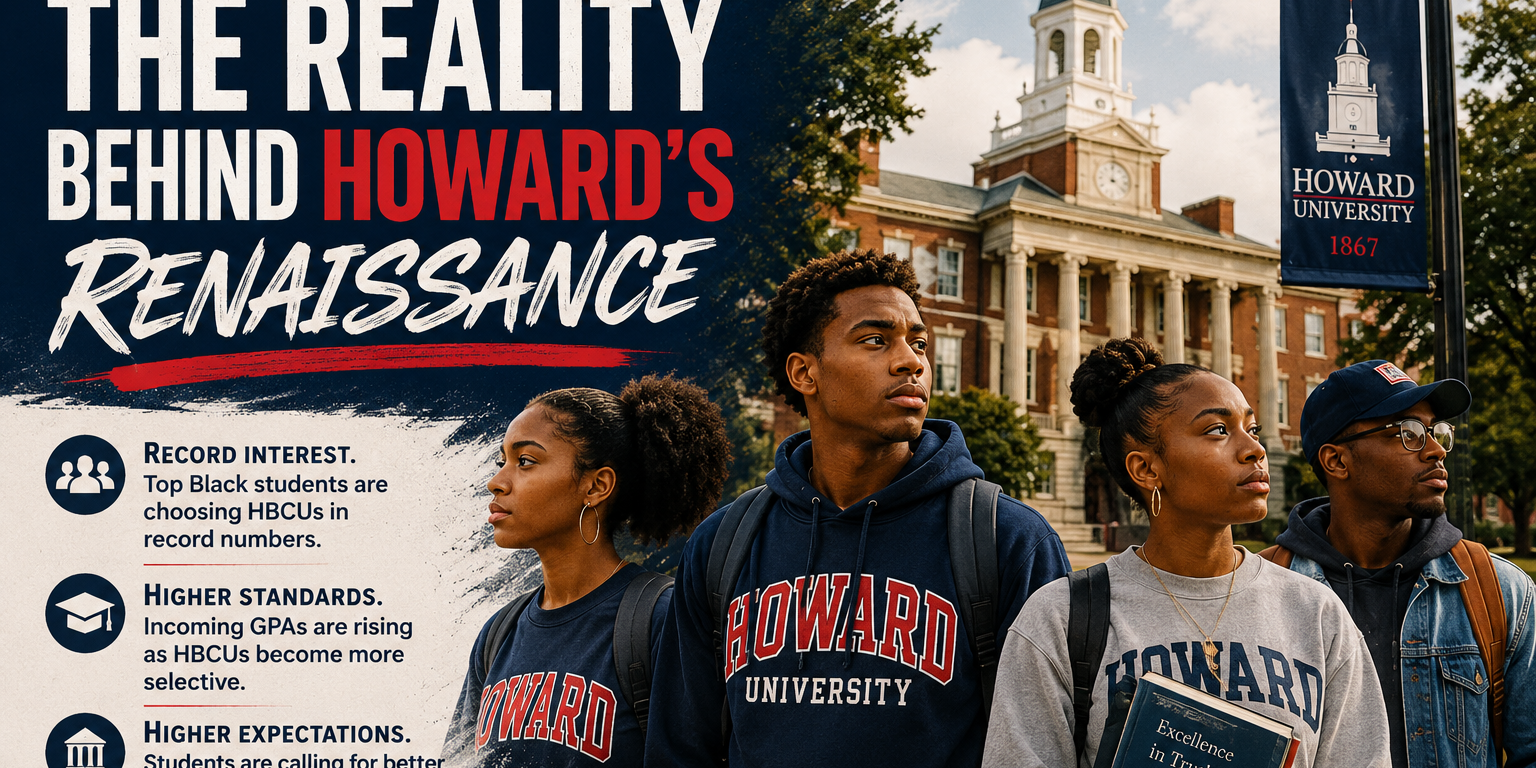
Top-ranking Black students nationwide are choosing historically Black colleges and universities (HBCUs) over Ivy League schools and other predominantly white institutions in record numbers. Applications to institutions such as Spelman College, Morehouse College, and North Carolina A&T have surged, while incoming GPAs continue to climb. Experts attribute much of this shift to the 2023 Supreme Court decision ending race-conscious admissions and the heightened national focus on HBCUs following the 2025 rollback of federal diversity initiatives. The statistics are clear: HBCUs—particularly Howard University—are experiencing a renaissance of interest, selectivity, and national attention.
The numbers tell one story, but the student experience tells another.
For many undergraduates, the gap between Howard University’s reputation and its day-to-day reality has become impossible to ignore.
Editor’s Note: The following is presented as a first-person perspective from a Howard University student and reflects that individual’s experiences and opinions.
I came to Howard expecting the academic equivalent of the Black Ivy League. After 16 years in the University of Chicago educational system, I expected intellectual rigor, administrative competence, and a campus culture that reflected Howard’s reputation. What I found was more complicated.
During my freshman year, Army ROTC gave me my first real sense of belonging on campus. The battalion was small but supportive. Black officers and upperclassmen challenged me to grow, treating me as someone capable of succeeding rather than someone who needed to be managed.
The following year, the battalion was absorbed into Georgetown University’s program after a shift in leadership. Black cadets took orders primarily from white officers, and the atmosphere changed with it. The Army is, of course, a hierarchical institution, but at an HBCU, the loss of that cultural understanding fundamentally altered the experience.
Outside of ROTC, the broader Howard community proved just as difficult to navigate. Social media has transformed campus life into a performance, where image often carries more weight than character. Forming genuine friendships can be difficult if you do not fit a particular aesthetic, social circle, or online identity. Being Black and educated is no longer enough to create automatic solidarity. Conversations around colorism, African diaspora identity, and status frequently overshadow the sense of shared purpose that many students arrive expecting.
That same emphasis on image is reflected in the classroom. I have seen students come to class in ski masks while others pair polo shirts with bonnets, reflecting a campus culture where standards of professionalism and decorum vary dramatically. Other HBCUs, including Morehouse and Spelman, have adopted classroom dress policies in recognition that presentation shapes both the learning environment and public perceptions of Black excellence. Howard has chosen a different approach.
Greek life and student organizations introduce another layer of Howard’s social hierarchy. Alongside academic, professional, and service organizations exists a growing network of modeling groups with little connection to major agencies or the fashion industry beyond campus. Some charge entry fees ranging from $25 to $200, impose strict rules about when members can go out or be photographed, and cultivate an exclusivity that often feels more cult-like than collaborative.
For students seeking status, visibility, or connections, the tradeoffs can become surprisingly steep, requiring not only money but a degree of personal autonomy as well.
Sororities, meanwhile, have largely replaced traditional hazing with subtler forms of social exclusion and performative displays of loyalty. Character often appears secondary to image. Many organizations present themselves as selective on the basis of integrity, scholarship, and values, yet students frequently question whether those standards are applied consistently in practice. Acceptance often depends on fitting an unwritten mold: dress the right way, socialize with the right people, and say the right things. Challenge the wrong person, and your standing can disappear just as quickly as it was earned.
The result is a culture that rewards performance over authenticity and conformity over individuality.
One of Howard’s greatest strengths has been its Russian language and history program. The curriculum takes seriously the often-overlooked connections between Russia and the Black diaspora, exploring the subject with the depth and nuance it deserves.
My Russian professor has been the most attentive, responsive, and encouraging instructor I have encountered in college. She consistently went beyond the responsibilities of a typical professor, offering the kind of guidance and mentorship I had not found elsewhere. She made a difficult language feel meaningful rather than simply another graduation requirement.
That experience demonstrated what Howard is capable of at its best.
Unfortunately, the same level of consistency has not extended across the university. International studies and study abroad remain burdened by the same administrative dysfunction that affects many other offices. When routine registration is already an obstacle, navigating overseas programs becomes even more daunting.
Administrative dysfunction compounds nearly every other problem on campus. Too often, the university’s priorities seem disconnected from students’ everyday experience. While financial aid and bursar emails can go unanswered for months, students continue paying rising tuition as dormitories struggle with broken air conditioning, recurring flooding, pest problems, and aging infrastructure.
At the same time, nearby dining options have steadily disappeared, leaving many increasingly dependent on an expensive meal plan with limited alternatives. The result is a campus where the cost of attending continues to increase while the quality of daily student life often feels as though it is moving in the opposite direction.
Leadership has done little to inspire confidence. Interim President Wayne A. I. Frederick has publicly rejected responsibility for the roughly 500 admitted freshmen who reportedly paid portions of their tuition but ultimately did not enroll. For many students, that response reflected a broader pattern: accountability often feels absent, even as the costs of attending Howard continue to increase.
Announcements of new housing projects and future investments offer hope, but they do little to address the day-to-day problems students face right now.
My own financial aid experience reflects the same pattern. Between November 2025 and August 2026, I sent 21 emails trying to resolve a loan the university had mishandled. None received a response. When I finally went in person, staff acknowledged that the mistake had originated within the university, offered a brief apology, and suggested I join a donor-funded waitlist.
That was the solution.
For an institution that proudly markets itself as a pillar of Black excellence, the way it handled a months-long administrative failure says more than any mission statement ever could.
Academically, the picture remains uneven. Some professors are exceptional; others fail to show up, cancel class without notice, or disappear from communication altogether. Grading standards vary just as widely. That inconsistency makes it difficult for Howard to credibly position itself alongside the nation’s most rigorous universities.
The problem extends beyond the classroom. Transcript requests, registration, financial aid, and degree audits remain slowed by outdated systems that peer institutions modernized years ago. Howard has received hundreds of millions of dollars in donations, grants, and investments, yet many students are left wondering why so little of that investment is reflected in the university’s basic infrastructure.
These problems are not unique to Howard, nor are they entirely new. They reflect deeper fractures that extend beyond a single campus: the lingering effects of social division, the erosion of genuine community, and the widening gap between institutional branding and everyday reality.
Older alumni frequently describe a different Howard—one less shaped by social media, status, and online tribalism. Whether that version was ever perfect is beside the point. For many current students, it no longer exists.
None of this changes Howard’s importance.
The university’s greatest strength has always been the people it produces. Its alumni built Howard’s reputation through generations of scholarship, leadership, public service, and cultural influence.
Today’s students deserve an institution that reflects the same standard.
Reputation can open the door, but only performance sustains it.
Until the administration treats competence as a prerequisite rather than an aspiration, the gap between Howard University’s reputation and its everyday reality will continue to grow.